This list of March food observances makes it easy for food content creators to brainstorm blog and email content ideas.
If you’re stuck for ideas for March content for your food blog’s email newsletters or social media channels, or you’re wanting to brainstorm recipe ideas or come up with fun food videos for your YouTube channel, check out all of these March food holidays. There truly is something for everyone and every type of food blogger and food content creator.
Many of these observances are based on dates in the United States but are often celebrated in the food community at large. I’ve tried to note where a month, week or day is tied to a specific country other than the USA. And where a day is observed globally, that has been noted as well.
Want more email tips? Subscribe to my monthly newsletter! Each month I write an exclusive newsletter full of tips, tricks and ideas for food content creators and their email lists!
This quick tip works equally well for email newsletters and product pages or product marketing launch pages. We’re talking about buttons – with a strong call to action.
I’m always looking for quick, easy ways to improve click throughs in emails or on product pages. Because sometimes, the simplest tweaks can result in the biggest rewards. And it’s always fascinating to me how the smallest change can completely alter a person’s behaviour!
So today, let’s talk about buttons. Particularly buttons with a strong call to action!
WHY YOU NEED TO USE BUTTONS IN YOUR EMAIL MARKETING
Most people who read your emails or scroll your product listings are probably doing so on their phones . ***
Clicking on text links on our phone is always a little more challenging than clicking while on a desktop or laptop – or even a tablet.
Big thumbs, small screens.
This is especially true when the links are short, one or two word text links.
If you’re not already, start using buttons in your emails and on web pages where you have an important call to action you want the reader to take.
They’re big, they’re bold, they stand out and, they’re easy to click when you’re holding a phone.
And unlike 5 or 10 years ago where including a button meant doing some coding, now they’re as simple as drag and drop so there’s no reason not to.
BONUS TIP: USE STRONG CALL TO ACTION LANGUAGE.
When you use a button, it’s important to use strong call to action (CTA) language that makes it clear what clicking the button will do.
Strong CTAs you might want to use include:
BUY IT NOW
GET YOUR EBOOK NOW
READ THE BLOG POST
GET THE RECIPE
SUBSCRIBE NOW
You can also use an arrow icon on the button to make it even clearer that something is going to happen when they click that rectangle.
Not that long ago I started transitioning clients from using the name of the recipe on a button to using a strong CTA.
So this…
Changed to this:
Every single one of them saw an uptick on click throughs by changing the CTA on the buttons. It was amazing what such a small change could do.
If you’re not already, try using buttons in your emails and on your website when you need the reader to take action.
If you are using buttons, make sure you’re using simple, strong language that directs the reader to take action.
Track your results and see the difference!
*** Not all email lists are the same. Don’t assume your readers are mostly mobile users even if that is the industry norm. Always check your data to see what your list is doing and tailor your emails accordingly!
Want more quick tips to help you with your email and digital product marketing? Subscribe to my monthly newsletter! Each month I write an exclusive newsletter full of tips, tricks and ideas for food content creators and their email lists!
It’s easy to get stuck trying to figure out what kind of content to put in your email newsletters but if you’re a food blogger or YouTuber, you already have loads of content ready and waiting to be used. Just look into your content archives!
One of the biggest challenges most food bloggers and food content creators have when it comes to consistently emailing their newsletter list is figuring out what to put in their emails.
But in reality, you probably already have more email content than you know what to do with!
REPURPOSE OLD BLOG CONTENT VIA EMAIL
If you’re stuck for something to send to your list, it’s time to… go back in time!
Your email marketing is the perfect platform to resurrect old content.
Your new subscribers? They haven’t read that old content.
Your old subscribers? They haven’t seen it in eons, possibly years and potentially not at all! (did you even email them regularly 3 years ago? 5 years ago? 10 years ago?)
While it’s important to update old content on your website regularly for SEO purposes, those rules don’t apply to your emails. If a post is old and doesn’t have the best photos or has a story about your Aunt Betty that the search engines aren’t interested in, it doesn’t matter. You can include it in an email.
Posts that are less popular in search can still get great click throughs in your newsletter (earning you some ad revenue) because it’s a different type of reader.
Think of it this way:
Most of us will never be able to rank on page one for a chocolate chip cookie recipe – the competition is waaaaay too fierce. But that doesn’t mean your recipe isn’t a great recipe!
In fact, your newsletter readers want to know what your chocolate chip recipe is because they trust you and like your content. That’s why they open your emails every week!!!
So share that 6 year old chocolate chip recipe in an email. They want to see it.
HOW CAN YOU REPURPOSE OLDER BLOG CONTENT INTO EMAILS?
Here are some easy ways you can repurpose your old content into emails:
⭐️ THEMED EMAILS: example: a Taco Tuesday theme. Make the email a digest of all your taco recipes. You can make themes as broad (cookies) or as specific (peanut butter cookies) as you like depending on the type of content you create.
⭐️ MENU EMAILS: create a complete menu for a meal. You can theme these as well.
Here are just a few ideas:
mother’s day brunch menu
takeout night at home menu
book club meeting menu
easy kids birthday party
the “soccer practice is at 7pm” menu
Expand this to a meal prep menu for the whole week if that’s your niche.
Expand this to a meal prep menu for the whole week if that’s your niche.
⭐️ SEASONAL EMAILS: Package up seasonal content on your site into individual emails. There are so many opportunities to do this.
For example, Halloween is in October. Package up old Halloween content into a series of October emails:
5 Ghoulish Halloween Treats
5 Fun Halloween Treats to Make with Kids
5 Spooky Halloween party cocktails
⭐️ LEFTOVER EMAILS: what happens after every holiday? We have leftovers. Using Halloween as an example again, send an email out right after Halloween with 5 Recipes That Use up Leftover Halloween Candy or 5 Recipes that Use upPumpkin Carving Leftovers. The recipes themselves don’t have to be Halloween related – they just have to be pumpkin or candy related – search your archives for pumpkin recipes. People always forget about leftovers!
These emails are also a great way to highlight minimizing food waste.
⭐️ TUTORIAL EMAILS: If you specialize in something, package up tutorials on your site into emails. Let’s say you make a lot of pies. Send out an email “Everything you need to know about making pie crust” and simply include 5 links to different pie crust recipes and tutorials on your site (how to make pie crust, how to make a two crust pie, savory pie crusts, how to do a lattice top, etc). You don’t have to write an essay on pie crust – just include the links with a short paragraph tying them all together.
⭐️ GREATEST HITS/POPULAR POSTS: Do recap emails highlighting the most popular recipes or posts on your site. Break it down further and do the most popular soups, desserts, weeknight dinners… you get the idea. Share your personal favourites. Readers like to know.
TIPS TO MAKE REPURPOSING CONTENT INTO NEWSLETTERS EASIER
Here are some simple tips to make repurposing blog or video content into newsletters easier for you or an assistant
✅ PRO TIP:keep a spreadsheet that contains a list of all the emails you send out each year.
Include the date of the email, the topic and the recipe or article names and links that were included. Use a new tab in the sheet for each year. Also make notes of any products or special offers you promote: either your own (recipe ebooks, printables etc) or non-Amazon affiliate links.
This helps ensure you don’t repeat links too frequently. I’ve noticed many of my clients tend to gravitate to the same 20-30 links over and over because they like the recipes or they perform well in search. But by having a record, it’s easy for me to show them we used that link two months ago and it’s too soon to repeat it.
✅ PRO TIP:a spreadsheet is easily searchable making it easy for you, or anyone helping you, to check and see the last time you included a taco recipe.
✅ PRO TIP:Try to wait at least 6 months to repeat a link. I prefer to wait longer but it really depends on your send frequency or the content you want to reuse. Sometimes sooner is better!
✅ PRO TIP:Repurposing content makes it very easy to write and schedule your seasonal emails well in advance. By repurposing your older Halloween or Christmas content you can probably have 10 seasonal emails written and scheduled by late September.
Leave space in your schedule to write an email for new holiday content or leave space in each email where you can add a new recipe that fits with the theme. But seriously… how nice would it be to have all those emails written before the busy holiday season even starts?
These are all really simple ways you can repurpose old content and make it earn its keep, while never running out of emails to send!
WANT MORE TIPS?
Want more email tips? Subscribe to my monthly newsletter! Each month I write an exclusive newsletter full of tips, tricks and ideas for food content creators and their email lists!
One of the biggest hurdles for food content creators when it comes to email marketing is… knowing what to send. What do you write about? How do you keep your emails interesting? Let’s start with some helpful tips for planning out email content for food bloggers.
One of the biggest reasons potential clients approach me to help them with their email newsletter marketing is that they’re tired of trying to figure out what to send to their list over and over again.
Everyone I work with is a food content creator. They might be a food blogger, YouTuber, Instagrammer, cookbook author, chef or even a food brand. What do they all have in common? They love food. And sharing food and feeding people. A few even love writing about food. But most of them would rather be in the kitchen than writing emails.
Because they don’t know what to write about. So let’s talk about planning out email content when you’re a food content creator!
The first steps to creating engaging food email newsletters include figuring out what your goals are and putting a plan together to help you achieve them.
STEP 1: TAKE STOCK OF WHERE YOU ARE WITH YOUR EMAIL LIST
Before you know where you’re going, you need to know where you’re at in your business. It’s time to ask yourself a few questions:
AND REMEMBER: no judgement here. All we’re going to do here is collect some data so no mean self-talk if you don’t like your answers!
When was the last time you sent your list an email?
Are you emailing your list consistently? How frequently?
When did you last clean up your email list?
What happens when somebody signs up for your emails?
Do you have any products you are promoting or should be promoting? Like these…
digital downloads like meal plans, checklists, shopping lists
ebooks
traditionally published books
classes or workshops you teach (remote or in person)
STEP 2: WHAT ARE YOUR BUSINESS PLANS FOR THE NEXT 12 MONTHS?
Outline your plans for your food blog or food content business for the next 12 months. A few things to consider include:
Do you have plans to diversify your revenue beyond ads?
Will you be launching any products, services or events this year?
Are you writing a book or having one released this year?
Will you be actively growing your affiliate revenue?
Do you have existing products/services etc that you want to see perform better?
Are you actively trying to grow your traffic?
Do you want to add more value to brand clients?
If you answered yes to any of the above questions, it’s time to focus on your email list.
STEP 3: TIME TO WARM UP THAT EMAIL LIST
We’ll address things like cleaning up your email list and automated welcome sequences in future articles. For now, let’s focus on getting an email out and establishing some consistency.
If it’s been a while since you sent your list an email, now is the month to do it.
⚠️ WARNING⚠️
Haven’t sent an email in a while (more than a month)?You will get unsubscribes. You may get a LOT of unsubscribes. Don’t panic, or stress. This is normal – people forget they signed up, their lives change or they’re no longer interested.
Take a deep breath and let them go. It’s short term pain for long term gain. And commit to emailing more often!
START WRITING
Sit down this week and draft a short email:
Give your list a big cheery hello and let them know you’ll be dropping into their inbox more often going forward. If you’ve decided how often, tell them. If you haven’t, don’t worry about it – the important thing is to open up communication now!
Give them a reason to stay subscribed – if it’s been a while since you last emailed, you may even have a lot of subscribers who’ve never received an email from you. Let them know what kind of content you plan to send them this year: recipes, kitchen hacks, shopping tips – whatever works for your niche.
⚠️ WARNING⚠️
Sending an email to your list where the only thing you’re doing is asking for money (aka “please purchase my new thing”) when they haven’t heard from you in months is pretty cheeky. Don’t be that friend who only shows up when they want something. Keep that list warm!
ALREADY EMAILING YOUR LIST REGULARLY?
Fantastic! That’s half the battle. Take a moment to review your send frequency and do a list cleanup.
✅ SEND TIP: Now is a great time to re-introduce yourself to your email list (it’s good to do this once a year actually!).
Send a fun email with 5 random facts about yourself
Give some hints about what you have in the works for the coming months
Ask for some feedback – what would they like more of? Less?
STEP 4: PLOT OUT YOUR FIRST QUARTER OF EMAIL CONTENT
The easiest way to stay consistent with email newsletters is to plan for it. You don’t need to map out the whole year. Start small.
decide on a send frequency (you can change it at any time)
roughly map out the big food celebrations for the year but focus on the current quarter
if possible, write a month’s worth of emails at a time (they don’t need to be long!)
if you already have a product or service, include a mention of it – just a short blurb in the footer of the email as a reminder that it’s something you offer. Do NOT make it the focus of the email.
schedule
repeat the process each month of the quarter.
✅ SEND TIP: deciding on a send frequency trips up sooooo many people:
There’s no right or wrong frequency and it will depend on your audience.
Don’t be afraid of experimenting
Consistency is key
My recommendation for a minimum send frequency is once a month. Any less and you risk people forgetting they signed up and then reporting you as spam. Most of my clients do a weekly send with once every other week being the second most common choice.
Follow these 4 steps and you’ll be well on your way to becoming more consistent with your email list and more engaged with your subscribers!
Want More Tips?
Want more email tips? Subscribe to my monthly newsletter! Each month I write an exclusive newsletter full of tips, tricks and ideas for food content creators and their email lists!
All digital products require consistent marketing to keep sales coming in. Here is a super simple way to to market your ebooks, printables or digital courses that isn’t too sales-y.(PS it also works for physical products!)
So… you’ve created this new digital product. Maybe it’s an ebook, or a downloadable printable. Or a digital course.
You’ve funneled time, money and energy into it and it’s perfect. It’s packed with helpful, practical information and tips. It’s beautiful to look at. And you just know it’s exactly what your people need to make their lives or businesses better.
There’s just one problem.
Nobody’s buying it.
Almost everyone who has launched a digital product has experienced this and it can be, at best, frustrating. At its worst, it can be a blow to your self-confidence and make you wonder why you’re doing what you’re doing.
One Key Thing You Need to Know About Selling Any Product or Service
Before you get too down on things it’s really important to know that most customers, or potential customers, require at least 7 touch points with your product before they’ll purchase. This is a key takeaway to factor into your digital product marketing plans! (oh and it also works for physical products!)
If you share your new product on Instagram , Facebook and Tik Tok once each, that’s 3 touch points…sort of.
If you have different audiences on each platform, it may only be once touch point for each of them…. maybe. If they didn’t see your post (because, algorithms) then it’s actually zero touch points!
Now you’re starting to see just how much marketing you’ll need to do to hit 7 touch points with most of your customers. You need to be promoting your new ebook constantly and consistently.
But what if you don’t want to be too sales-y?
I get it. It feels weird and awkward and even you get sick of hearing yourself talk about your new baby.
So here’s a super simple tip that takes very little effort and helps you get eyeballs regularly on your products.
Promote Your Digital Products to Your Email List In Every Newsletter
Before you groan, this is not as sales- y as it sounds.
Here’s what you are NOT going to do:
you are NOT going to go on and on about your product in each newsletter
it is NOT going to be the first thing, or even the second or third thing you talk about
you are NOT going to annoy your subscribers
Here’s What You ARE going to do:
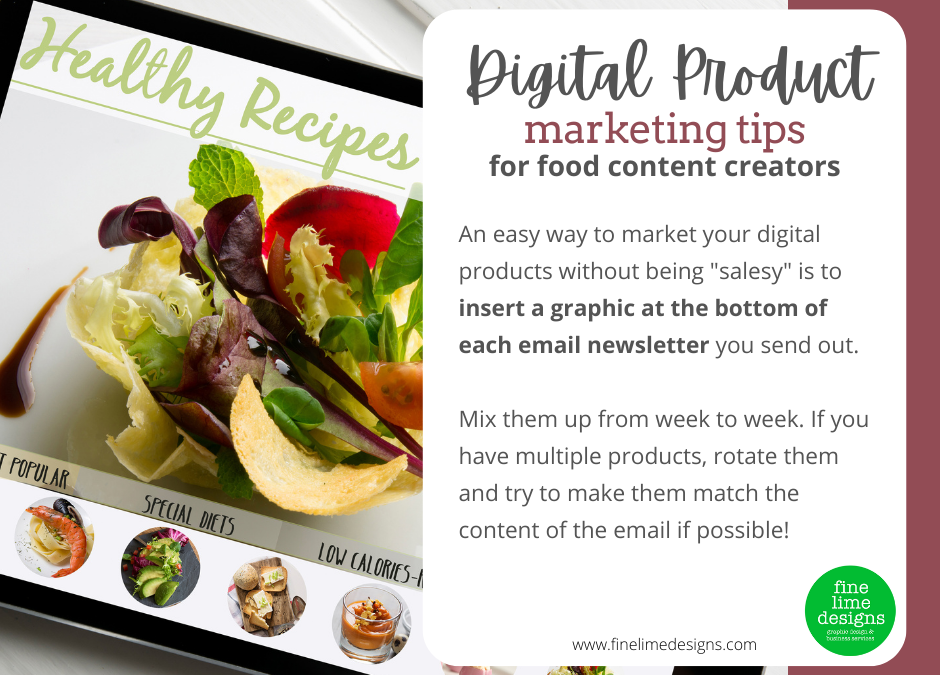
Create 3-4 different graphics for each product you have. Aim for about 640px wide by 200px high – about the width of your newsletter
Your graphics should show an image of the product (a book cover, the logo for your course etc) and have a small amount of text encouraging people to buy
Insert one of the graphics into the bottom of your next newletter, just above your sign off – like an ad!
Make sure the graphic links to somewhere they can buy the product
If you like, you can also write a short paragraph blurb highlighting a great feature or benefit of your product. If you do this, make sure you include a text link so they can buy
Add a button that says something like “GET YOURS NOW” or “BUY NOW”. Buttons convert well in emails – better than images and text links
Rotate your graphics each week so they don’t see the same image every week.
If you have multiple products, rotate the product you feature each month – if you can tie it into the theme of your newsletter or a key point in your newsletter that’s even better.
By doing this, you’re not in your subscribers faces each week. You’re not pushing them to buy.
You’re simply reminding them that you have this product and, when they’re ready, it’s there waiting for them.
You also need to remember that each week, you have new subscribers who have never seen your product before. They are starting from zero touch points!
You’ll still need to regularly promote your products on social media and to your network but that’s a tip for another day!
In the meantime, add these graphics into your rotation and it’s a very simple way to market your books, products and courses every week to the people who are most likely to buy from you!